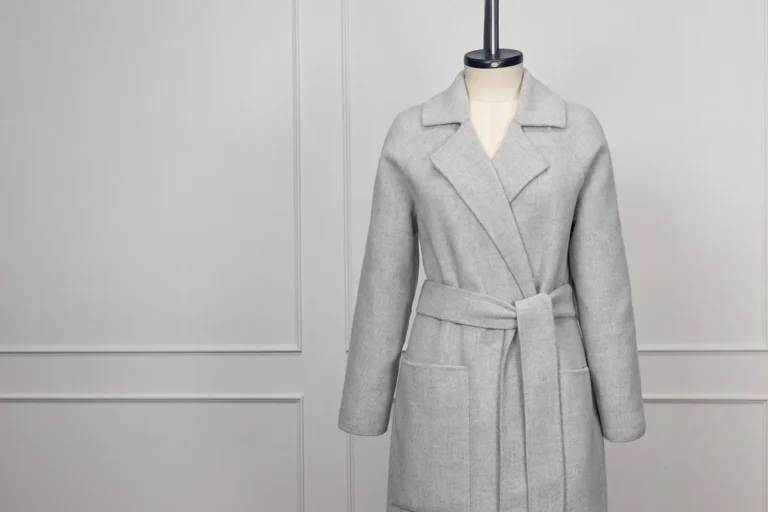
In this final class of the series, I move from preparation and drafting into constructing the coat itself, and teach you how to sew an unlined double faced wool coat.
This coat is made from splittable double-faced wool, which allows me to create a completely unlined garment with clean, hand-finished internal seams. Instead of a lining, the inside of the coat is finished using hand sewing.
Sewing this coat?
You can now make the exact design featured in this tutorial using the Cresswell Coatsewing pattern, which includes the pattern pieces, detailed instructions and this free video series as a sew-along.
This is Class 3 of a three-part series:
Class 1: How to sew double-faced (splittable) wool – Blog Post
Class 2: Drafting an unlined coat pattern – Blog Post
Class 3: Making the coat (this tutorial) – Watch YouTube Tutorial
If you haven’t already, I strongly recommend watching Class 1 before starting this journey. In this class, I assume you’re familiar with:
separating fabric layers
finishing edges in splittable fabric
sewing darts in splittable fabric
ladder stitch and slip stitch
Cut all pattern pieces accurately.
If your fabric has a nap, use a nap layout. Tutorial on nap: Watch Here.
Transfer all markings clearly:
notches
roll line
pocket placement
belt loop placement
Tailor’s tacks or thread tracing work particularly well on wool.
Front – cut 1 pair
(mirror image)
Left Back – cut 1
Sleeve – cut 1 pair
(mirror image)
Collar – cut 1
(cut on fold or as a single piece)
Pocket – cut 2
Belt – cut 1
(or cut 2 if using a centre back seam)
This coat relies on three types of stitching, used consistently throughout:
1. Basting Stitch
Stitch length: 4 mm or longer
Distance: ½” / 1 cm from raw edge (double seam allowance)
Purpose:
acts as a stop line for separating layers
controls where seams start and stop
Sew with a contrasting thread (but a colour that can be removed from your fabric)
Secure with a single backstitch at start and end
Complete a basting stitch around all of the pattern pieces or follow this detailed list:

2. Guide Stitch
Stitch length: 2.5 mm
Distance: ¼” / 5 mm from raw edge (same as seam allowance)
Sew in matching thread (this stitch stays in)
Used as an accurate folding / finishing line for hand sewing
3. Hand Sewing
Ladder stitch: for finishing edges
Slip stitch: for sewing the inside of seams
Stitch size: 3 to 5 mm, smaller over bulky areas
Do not pull tightly – stitches should sit flat and invisible
4. Seam allowance is ¼” / 5 mm.
The coat is assembled in this order:
Patch pockets
Sleeve darts (shoulder + elbow)
Centre back seam + kick pleat
Collar + collar band
Back raglan seams
Front raglan seams
Side seams + underarm seams
Sleeve hems + coat hem
Front edges + lapels
Attach collar with hanging loop (optional)
Belt + belt loops
Final pressing and finishing
Preparing the Pocket
Apply a basting stitch all the way around the pocket.
Separate fabric layers up to the basting stitch.
Guide stitch:
both seam allowances along the top edge
front seam allowance around the sides and bottom edges
Trim seam allowances where guide stitching is completed.

Attaching the Pocket
Mark pocket placement clearly on the garment front.
Position pocket right side up on the right side of the garment. Matching the guide stitch or stitching line on the pocket to the pocket placement markings on the garment front.


Sew:
start at top right corner
sew down, around bottom, and up the left side
fold the top edge of the pocket (at the start and end), along the guide stitch, to finish this area
Secure start and finish with backstitch.


Hand Finishing
Ladder stitch the pocket opening.

Slip stitch the remaining edges.

Add bar tacks at pocket corners:
¼” / 5 mm in from edge
¼” / 5–10 mm long


This sleeve has two darts: shoulder and elbow.
Dart Preparation
Mark dart stitching lines on the wrong side.
Add basting stitch:
shoulder dart – back of sleeve
elbow dart – lower dart leg (closest to hem)
Basting stitch placement:
½” (1 cm) from fabric edge
¼” (5 mm) from dart stitching line
extend ¾” (2 cm) beyond dart point


Sewing the Dart
Separate the fabric layers on the side of the dart with the basting stitch. Up to and through the dart point.

Guide stitch along the dart stitching line. On the wrong side of the separated seam allowance.
Position the two layers of material together to sew the dart. Matching the side without the basting stitch, to the top separated seam allowance of the side with the basting stitch. Sew dart from opening to point.
Press dart toward basting stitch using a ham.
Trim seam allowances of the sewn dart and guide stitched seam allowance.
Slip stitch separated seam allowance to cover dart seam.


Preparation
Left Back
Basting stitch along centre back.
Separate layers.
Guide stitch on back separated seam allowance.
Right Back
Basting stitch along kick pleat angle and straight edge.
Separate layers.
Guide stitch:
both layers along straight edge
back layer only along angled edge


Sewing
Sew centre back from neck to top of kick pleat.
Press seam toward left back.
Trim as required.


Hand Finishing 1
Slip stitch centre back seam (stop 4″ / 10 cm above pleat).


Sew Kick Pleat Angle


Hand Finishing 2
Clip into seam allowances at kick pleat corner.
Hand sew:
finish centre back seam – slip stitch
angled pleat seam – slip stitch
straight kick pleat edge – ladder stitch
Reinforce kick pleat corner with extra stitches.


Preparation
Collar
Basting stitch along outer edges only. Do not need to complete a basting stitch on the seam that will join to the collar band.
Separate layers (not the collar-band seam).
Collar Band
Basting stitch all the way around.
Separate layers all the way around.
Guide stitch on back separated seam allowance where collar attaches.

Assembly
Attach collar to collar band.
Start and stop sewing at the basting stitch.
Press seams toward collar band.
Trim seam allowances.
Slip stitch seam to finish.


Back Raglan
Complete a basting stitch and separate layers.
Guide stitch on back separated seam allowance.
Sew sleeve to back from neck edge to basting stitch. Stop sewing at the basting stitch for the underarm.
Press seam toward back.
Slip stitch, stopping at basting stitch.


Front Raglan
Complete a basting stitch and separate layers.
Guide stitch on back separated seam allowance.
Sew sleeve to front from neck to underarm (do not need to stop at basting stitch).
Press seam allowance toward front.
Slip stitch entire seam.


Complete a basting stitch along back side seam and underarm seam.
Separate the two layers up to the basting stitch.
Complete a guide stitch on back separated seam allowance.


Sew front to back from sleeve hem to garment hem, starting and stopping at basting stitches at either end.
Press seam allowances toward back.
Trim seam allowances.
Slip stitch from hem to hem, starting and stopping at basting stitches at either end.

Complete a basting stitch on all hems.
Separate layers.
Complete a guide stitch on both separated seam allowances.
Trim as needed.
Fold seam allowances into middle along the guide stitch.
Ladder stitch by hand.
Add extra stitches over bulky joins.


Cut 4″ / 10 cm × 1¼” / 3 cm – usually cut on the bias and stretched
Sew long edge, turn, press.
Shape curve with steam.
Preparation
Front edges + lapels:
complete basting stitch
separate layers of fabric
guide stitch on both sides of the separate seam allowances
Collar:
basting stitch around outer edge
guide stitch:
both sides of the seam allowance along outer edge (from collar notch that joins to garment)
back separated seam allowance only along neck edge

Sewing
Match notches.
Tack collar in place.

Sew neckline from notch to notch. Reinforce hanging loop.
Check collar symmetry and puckers.
Trim seam allowances.
Press seam allowances towards collar band.


Hand Finishing
Ladder stitch collar outer edge.
Clip into lapel seam allowance (2–3 mm from stitching). At the notch where the collar and garment connect.
Finish lapel and front edge with ladder stitch.
Slip stitch neckline of collar.
Transition stitches neatly at collar join.


Belt
One-piece or centre-back seam option.
Complete the basting stitch along all outside edges.
Separate layers of fabric up to the basting stitch.
Guide stitch both sides of the separated seam allowance, along outside edges.
Trim as required and ladder stitch.


Belt Loops
Cut the belt loop pattern pieces from fabric layers that have been completely separated to reduce bulk.
Guide stitch short edges.
Sew long edges, stopping ⅝” / 1.5 cm from ends.
Turn and press.
Attach symmetrically with the sewing machine sewing ¼” / 5 mm from short edge to the back edge of the side seam.
Hand sew short edges.
Reinforce with a second row of machine stitching approximately ⅜” / 1 cm from first seam.
Press flat, use a clapper if required.


Remove all basting stitches.
Steam roll line using a folded towel.
Allow garment to cool before moving.
Final press.
You now have a fully hand-finished, unlined double-faced wool coat – clean inside and out, with couture-level construction.
Wear it with pride.