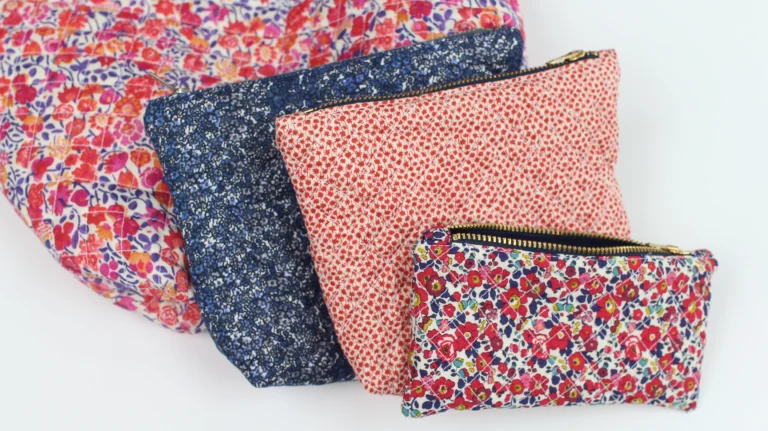
If you’ve already watched my How To: Quilting Wash Bag Tutorial on YouTube and read the accompanying How To: Quilted Wash Bag blog post, you’ll have a solid understanding of how the basic bag is constructed.
At this stage, you may wish to personalise the project, adjusting the size and proportions to suit your needs. This post explains how I calculate the sizing, so you can confidently design your own wash bag in any size.
In the original tutorial, I shared three sizes: small, medium, and large, but once you understand the system behind the measurements, resizing the bag is straightforward.
The easiest way to change the size of the wash bag is to start with the zip length.
This is particularly helpful if you want to use a metal zip, as these can be difficult to shorten.
Measure the zip from the beginning of the teeth to the zip stopper at the end. This is the zip length and determines the width of the bag.
The zip is always positioned centrally across the top of the bag.
To turn the zip length into the finished bag width, a few extra allowances are added.
I always recommend using zipper tabs, as they give the bag a professional finish. The size of the tabs stays the same, regardless of the bag size.
Here’s how I build up the width:
½” (1cm) on each side for zipper tabs
⅛” (3mm) on each side to create a small gap between the zipper tabs and side seam
½” (1cm) on each side for seam allowances
Seam Allowance | Gap | Zip Tab | Zip Measurement | Zip Tab | Gap | Seam Allowance
Imperial: 1/2″ | 1/8″ | 1/2″ | Zip Measurement | 1/2″ | 1/8″ | 1/2″
Metric: 1cm | 3mm | 1cm | Zip Measurement | 1cm | 3mm | 1cm
I don’t use exact imperial-to-metric conversions. Instead, I work with simple, easy measurements.
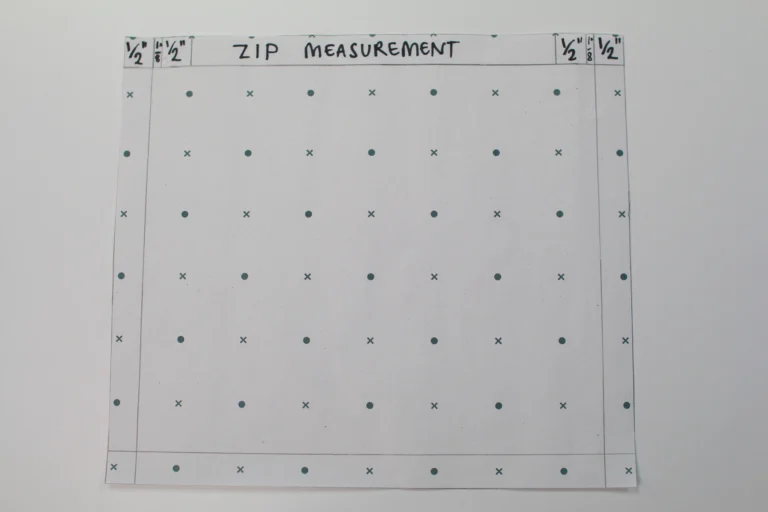
Example: Calculating the Width
If your zip measures 8″, add:
8″ zip + 1″ zipper tabs + ¼” gaps + 1″ seam allowances = 10¼” total fabric width.
In metric, for a 20cm zip:
20cm zip + 2cm zipper tabs + 6mm gaps + 2cm seam allowances = 24.6cm total fabric width.
The height of the bag is completely flexible and depends on how you plan to use it.
Once you’ve decided on your finished height, add:
½” (1cm) to the top for a seam allowance
½” (1cm) to the bottom for a seam allowance
If you’re using a plastic zip, it can be shortened easily.
To do this, measure the desired zip length from the zipper pull.
Mark the desired finished zip length with a pin. Measure an additional ½” (1cm) beyond this point before cutting the zip. This extra length allows room for the zipper tab, which will cover the cut end during construction.
If you are working with a metal zip you will need to remove the teeth at the top of the zipper instead. I usually find this easiest to do with a pair of small pliers.
The zip should always sit centrally across the width of the bag.
When sewing the zip into the lining and outer fabric, measure 5/8″ (1.3cm) in from each side seam. This measurement comes from:
½” (1cm) seam allowance
⅛” (3mm) gap
Correct zip placement helps achieve clean corners and a well-shaped finished bag.
Once the sizing is understood, it’s easy to customise the quilted wash bag to suit any purpose, from makeup bags to travel pouches.
Follow my complete How to Make a Quilted Wash Bag tutorial for step-by-step instructions on quilting the fabric, inserting the zip, adding the lining and creating the boxed corners.