Learn how to sew a V-Neck A-Line dress – Step-by-Step Construction Guide
This tutorial walks you through the complete construction process for a sleeveless V-neck A-line dress with a loose lining, in-seam pockets, an invisible zipper, and a faced hem.
This is Class Two in the series, Watch on YouTube. In Class One, the dress was drafted – Watch it Here | Read about it Here. Here, we focus solely on professional garment construction, step by step.
You can make this dress:
Above the knee or longer length
Sleeveless or adapted with sleeves
In summer fabrics (linen, cotton)
Or winter fabrics (wool, tweed, bouclé)
Sew This Dress with the Neve Pattern
Want to sew this V-neck A-line dress using a ready-to-print pattern? The Neve Dress Sewing Pattern includes short and midi length options, a full lining, in-seam pockets, an invisible centre-back zip and hem facing.
Shop the Neve Dress Sewing Pattern
Sewing darts in both lining and outer fabric
Constructing in-seam pockets – for a more professional method check out this Blog Post | Video
Sewing a lined V-neck neckline
Finishing armholes with a lining
Inserting an invisible zipper with a lining
Sewing a faced hem
Anchoring lining for a professional finish
I use an overlocker/serger to finish raw edges.
If you don’t have one, you can:
Use an overcast stitch on your sewing machine
Use pinking shears
Use an alternative seam finish such as a French seam
Outer Fabric
1 x Front (cut on fold or with centre front seam)

2 x Back

1 x Front Hem Facing
1 x Back Hem Facing

2 x Pocket Bags

Lining Fabric
1 x Front Lining (cut on fold or with centre front seam)
2 x Back Lining
2 x Pocket Bags

Mark the notches, darts and pocket placements before sewing.
My garment has 1 cm (⅜”) seam allowances everywhere.
This step is essential to prevent stretching and distortion.
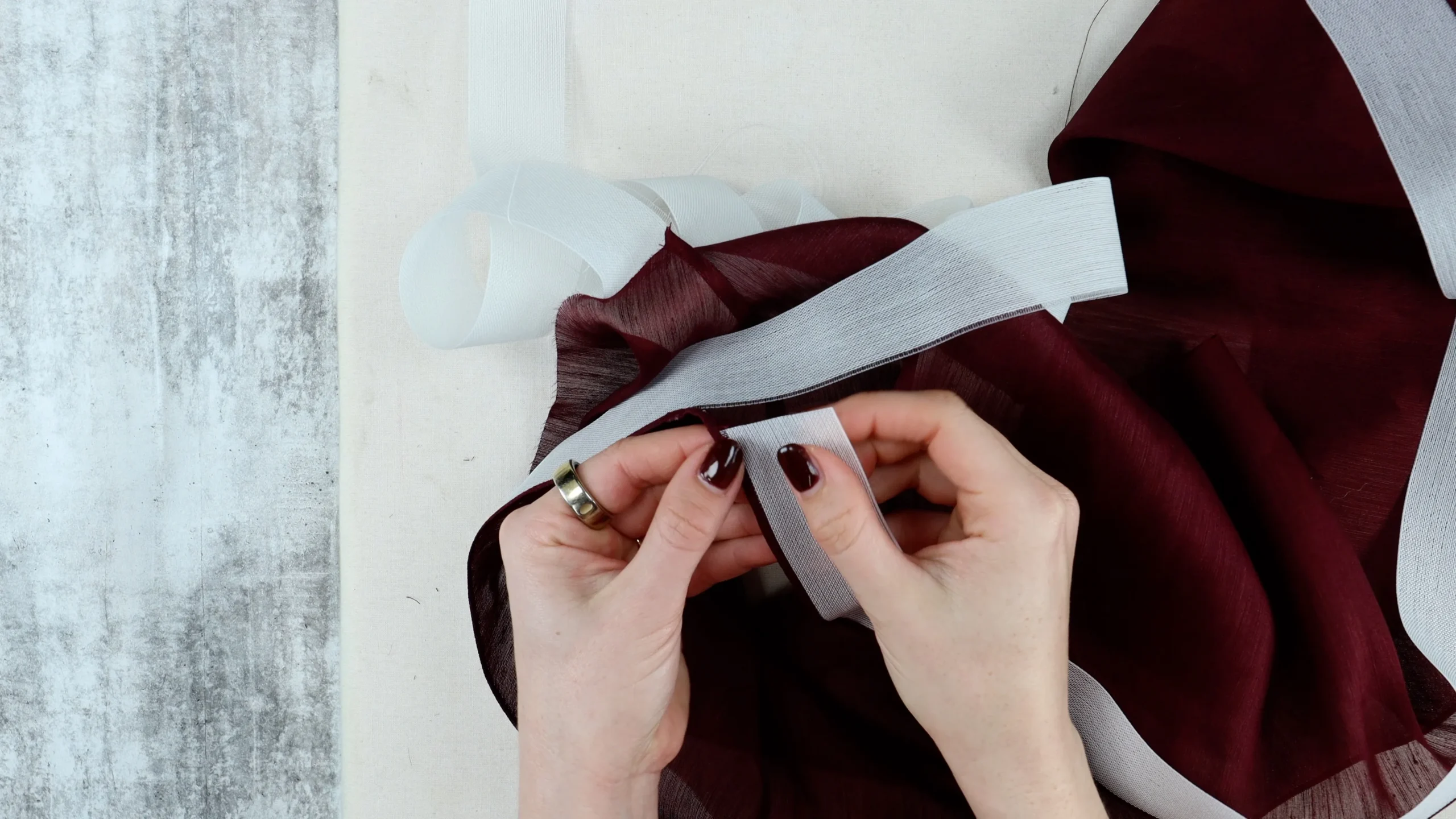
Stabilise the Following Areas:
Front V Neck – fusible stay tape
Back Neck – fusible stay tape
Armholes (front and back) – fusible stay tape


Pocket Openings – straight of grain tape


Centre Back Zipper Placement – straight of grain tape

Front and Back Hem Facings – lightweight woven fusible interfacing


Key notes:
Use fusible stay tape or bias-cut stabiliser
Reinforce the very bottom point of the V-neck (if stay stitching and not using a stay tape)
Pocket stabiliser should extend – 1 cm / ⅜” above and below pocket notches
Zipper stabiliser runs from neckline to 2 cm / ¾” below zipper notch
Mark dart stitching lines.

Pin dart legs together.
Sew from side seam toward dart point.
Sew off the fabric at the point.
Finish cut-away darts with an overlocker / serger.
Tidy the overlocker / serger threads by threading the thread at point of the dart through a large eyed darning needle, and threading back up underneath the overlocking / serging stitching.


Press darts downward toward the hem using a tailor’s ham

Repeat for:
Outer fabric darts
Lining darts
Overlock the curved outer edge of all four pocket bags. Do not trim fabric while overlocking.
Press pockets flat

Check pairs match with no distortion.
Front Dress
Attach lining pocket bags to front dress
Place fabric right sides together
Stitch using a reduced seam allowance (¼″ / 5 mm)

Back Dress
Attach outer fabric pocket bags to back dress
Right sides together
Stitch with the same reduced seam allowance
Double-check pocket placement symmetry between both front and back patterns
Overlock / serge side seams (including pocket edges).
Press seams flat.
Press pocket away from garment.

Edge stitch pocket bags to the seam allowances to keep pockets inside garment.


Sew outer fabric shoulder seams
Sew lining shoulder seams
Press seams open or towards the back

Check out a detailed V-Neck sewing video on YouTube: Watch
Place outer and lining right sides together.
Align neckline edges and shoulder seams – match using a Clover Fork Pin if required.
Draw V-neck stitching line onto garment if needed.

Sew neckline in two passes, starting 5 cm / 2″ from V. Pivot exactly at the V point.

If you are working with a centre front seam. The centre front seam must be sewn to meet the stitching line at the neckline, no further.

Stop sewing the V-Neck at the front seam. Sew both sides of the V separately.
Do not sew over the seam allowances at the V.
There may be a tiny gap (stitch length) at the V point, this is ok.


Clip precisely into the V (2 mm / ⅛” from stitching)
Press seam allowances open
Trim or grade if fabric is bulky

Push seam allowances toward lining
Understitch on lining only
Stop short of centre back by 1.5cm / ⅝” for zipper insertion
Press so lining rolls just inside neckline

Bring lining and outer right sides together.
Match shoulder seams and side seams.

Sew armholes in one continuous pass per side.

Clip curves. Trim and grade if needed.

Turn garment right side out by putting your hand between the lining and outer fabric at the front shoulder and pulling the back through to the front. Complete for both sides.


Pin outer fabric side seams.
Pin lining side seams.
Pin pockets together.

Sew from hem to pocket to underarm.
Pivot carefully at pocket corners
Reinforce pocket corners if needed by reducing the stitch length to 1.5 mm or sewing over the pocket corner a second time (2cm / ¾” either side of the corner)

Press seam allowances carefully:
Outer seams and pocket toward front

Lining seams toward back (to reduce bulk)

Sew in two passes from underarm toward shoulder (stopping approximately 5 cm (2″) from shoulder seam)
Understitch on lining only
Press so lining rolls inside armhole


Sew centre back seams up to zipper notch (outer + lining).
Press seams open.

Insert invisible zipper into outer fabric. Check zipper alignment from both sides before proceeding.


If required press the zipper using pieces of card under the zipper to prevent embossing on the right side.

Secure the bottom of the zipper tape onto the seam allowances using a bar tack; 3-4 stitches forwards and backwards.


Attach zipper to lining by machine.


Fold the top edge of the zipper tape out of the way, to prevent bulk at the neckline.


Check the work from the right side before sewing.


The top edge of the lining can be tricky to sew. If required, start a small distance away from the neck edge, sew along the lining using a 5mm / ¼” seam allowance.
Stop sewing just before, or in line with the centre back seam in the lining.
Then return and sew the neckline from the seam towards the neckline edge.


The seam should look like this.


Sew side seams of hem facings.
Press seams open.


Press top edge of hem facing under by seam allowance 1 cm (⅜”).

Attach hem facing to dress hem.

Understitch seam allowances towards hem facing.

Edge stitch top edge of facing onto the garment.

Press hem allowance by seam allowance 1 cm (⅜”)

Create a narrow double-fold hem; 5mm / ⅛” x 5mm / ¼”
Edge stitch close to folded edge

Press neatly

Underarm Anchor
Bar tack lining to outer fabric at base of dart; attaching lining and outer seam allowances together

Optional Finishing Touches
Hand-sewn hook & eye at top of zipper

Thread chains at side seams to control lining – Read Blog Post | Watch Video

You now have a professionally constructed V-neck A-line dress, fully lined, with secure pockets, a clean neckline, and a beautifully finished hem.
In the next class, I demonstrate an alternative in-seam pocket method that keeps the pocket permanently in place towards the front of the garment: How to Sew an Inseam Pocket
Make the Neve Dress
If you’d like to make this dress without drafting the pattern yourself, the Neve Dress Sewing Pattern is available as a digital PDF pattern with short and midi length options.